Summary

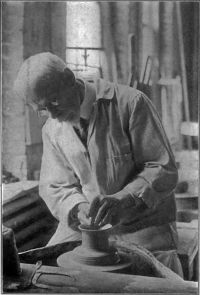
Portrait of Charles Fergus Binns Charles Fergus Binns The Potter's Craft: A Practical Guide for the Studio and Workshop

This is done sometimes by such versatile workers as the Japanese, but it may be laid down as a law that a production of the nature of a tour-de-force, an object which simply excites wonder at the skill of the worker, is undignified and meretricious. It is akin to the work of certain painters who delight in painting marble or velvet so as to exhibit a perfect texture only and is but one degree removed from the skill of the pavement artist who with colored chalk draws a lamb chop or a banana in such a manner that the real article seems to be lying on the ground at his feet.
Source: Gutenberg

Portrait of Charles Fergus Binns Charles Fergus Binns The Potter's Craft: A Practical Guide for the Studio and Workshop

Much of the glamour of the potter's art is associated with the wheel. Poets have sung its praise and artists have delighted in its rhythmic motion, but alas! the wheel as a commercial method of manufacture is doomed to extinction. It cannot compete with the precision and speed of machinery. It devolves, therefore, upon the artist potter to maintain the wheel in its rightful place as, par excellence, the potter's tool.
No clay worker's studio should be without a wheel, but the particular form of wheel depends upon the nature of the circumstances under which it is to be employed.
Source: Gutenberg

Portrait of Charles Fergus Binns Charles Fergus Binns The Potter's Craft: A Practical Guide for the Studio and Workshop

But the consciousness of the existence of such a blemish will destroy the pride of achievement which should accompany every finished piece.
If the worker aims to draw any expression of opinion from the untrained observer it should be in the nature of a remark on how easy the work looks. Art will always conceal effort. Just as the poet or orator is at his best when he clothes sublime thought in simple words so the artist or craftsman glorifies his vocation when he makes use of means which appear to be within the reach of every observer.
Source: Gutenberg

Get perspective with Kwize: daily news enlightened by great literature