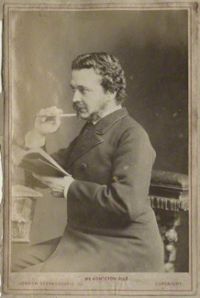
Charles Hamilton Aïdé

Charles Hamilton Aïdé

Summary

Portrait of Charles Hamilton Aïdé Charles Hamilton Aïdé A voyage of discovery

Grace, clad in her ulster and stalking-cap, did not fear the wind, but, as it rendered talking difficult, she proposed that they should seek the shelter of the fir-wood. There, the turbulence of the wind was only heard in the upper branches; a great quiet reigned over the soft, tawny soil, carpeted with pine-needles, upon which their footsteps fell.
His beginning was not happy.
"Why are you going away? Why do you go and stay with those Barhams, a country minister and his wife, with whom I am sure you can have nothing in common?"
"I like Mrs. Barham and her son very much—that is why I go."
Source: Gutenberg

Portrait of Charles Hamilton Aïdé Charles Hamilton Aïdé A voyage of discovery

But Grace Ballinger was a woman, and not above a woman's weaknesses. She liked appreciation—admiration—call it what you will; and, though possessed of no craving to have a man always at her feet, the constant occupation—it might almost be called the devotion—of a clever and original one was certainly agreeable to her. She did not even now realize all that this meant to Ferrars. He sought her as he did no one else; but his reticence as to his own feelings on every personal subject blinded her to the fact that she was growing to be of paramount importance in his scheme for the future.
Source: Gutenberg

Portrait of Charles Hamilton Aïdé Charles Hamilton Aïdé A voyage of discovery

She turned her sweet, smiling face to him.
"I am sorry I am engaged," he replied, quickly, without looking at her. "You have so many men—so many more than ladies—you can't want me. My aunt and my sister must answer for themselves."
She was so little used to contradiction that she seemed literally struck dumb. Who was this man, whom she regarded as her slave, that he dared resist her sovereign will and pleasure?
"Grace and I will look in to wish you good-by, after dinner. But it is not 'good-by' for long, I believe?" said Mrs. Frampton, in high good-humor at Mordaunt's firmness.
Source: Gutenberg

Get perspective with Kwize: daily news enlightened by great literature