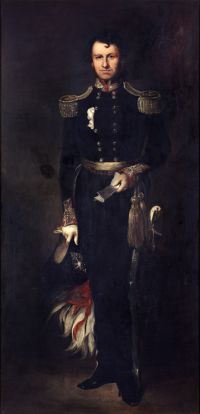
Charles Joseph Latrobe

Charles Joseph Latrobe

Summary

Portrait of Charles Joseph Latrobe Charles Joseph Latrobe The Rambler in Mexico (1836)

Look at their works: the moles, aqueducts, churches, roads—and the luxurious City of Palaces which has risen from the clay-built ruins of Tenochtitlan, at a height above the ocean, at which, in the Old World, the monk of St. Bernard alone drags through a shivering and joyless existence!
If the general features of the valley of Mexico are thus striking, those presented by the capital are not less so. In both its general plan and position, and the solidity and grandeur of its details, it has impressed me with a greater idea of splendour than any city I have seen in either hemisphere.
Source: Wikisource

Portrait of Charles Joseph Latrobe Charles Joseph Latrobe The Rambler in Mexico (1836)

And when approaching the main valley, the villages thicken around him, with their streets cheered and beautified, amid the general sterility, by groups of the graceful Peruvian pepper tree; and the roads are seen crowded by long strings of laden mules, and gay cavaliers—and the stupendous works of human design, harmonize with those of nature, and prepare him for the sight of the most extraordinary scenes in the world, whether we regard the works of men, or those of God, the artificer of all. And such is the valley and city of Mexico.
Source: Wikisource

Portrait of Charles Joseph Latrobe Charles Joseph Latrobe The Rambler in Mexico (1836)

Then came the little opening at the entrance of some lateral valley, with its Indian hamlet, strips of cultivation fully exposed to the broad sun, and groups of rich and sunny bananas, half shrouding the simple cabins of the poor natives: or, as a contrast, one of those dens of rubbish, situated under the shade of a beetling crag, in which everything seemed devoted to putrid destruction; where you moved in twilight through a mass of decaying vegetation; where no living thing sported, and the passenger breathed the chill and humid damp of death, rottenness, and decay.
Source: Wikisource

Get perspective with Kwize: daily news enlightened by great literature