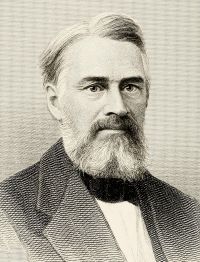
Charles Louis Flint

Charles Louis Flint

Summary

Portrait of Charles Louis Flint Charles Louis Flint Milch Cows and Dairy Farming

The object with many seems to be to see with how little food they can keep the cow alive. Now, it appears to me that the milch cow should be regarded as an instrument of transformation. With so much hay, so much grain, so many roots, how can the most milk, or butter, or cheese, be made? The conduct of a manufacturer who owned good machinery, and an abundance of raw material, and had the labor at hand, would be considered as very absurd, if he hesitated to supply the material, and keep the machinery at work at least so long as he could run it with profit.
Source: Gutenberg

Portrait of Charles Louis Flint Charles Louis Flint Milch Cows and Dairy Farming

Keep the cows constantly in good condition, ought, therefore, to be the motto of every dairy farmer, posted up over the barn-door, and over the stalls, and over the milk-room, and repeated to the boys whenever there is danger of forgetting it. It is the great secret of success, and the difference between success and failure turns upon it. Cows in milk require more food in proportion to their size and weight than either oxen or young cattle.
Source: Gutenberg

Portrait of Charles Louis Flint Charles Louis Flint Milch Cows and Dairy Farming

Where butter-making forms a chief branch of dairy business, the particular form and size which have been used for a long time are adhered to, because dairymen know very well that the public recognizes their choice butter by the form and size of the casks, and buys it the more readily. The greatest anxiety of the Dutch butter-maker is to keep up the old, well-earned reputation which Dutch butter has in every foreign country, both for its intrinsic good qualities, the result of the process of manufacture, and for its extraordinary appearance as an article of commerce.
Source: Gutenberg

Get perspective with Kwize: daily news enlightened by great literature