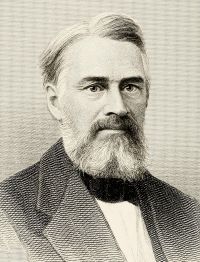
Charles Louis Flint

Biographical details

Portrait of Charles Louis Flint Charles Louis Flint Milch Cows and Dairy Farming

The object with many seems to be to see with how little food they can keep the cow alive. Now, it appears to me that the milch cow should be regarded as an instrument of transformation. With so much hay, so much grain, so many roots, how can the most milk, or butter, or cheese, be made? The conduct of a manufacturer who owned good machinery, and an abundance of raw material, and had the labor at hand, would be considered as very absurd, if he hesitated to supply the material, and keep the machinery at work at least so long as he could run it with profit.
Source: Gutenberg

Portrait of Charles Louis Flint Charles Louis Flint Milch Cows and Dairy Farming

Keep the cows constantly in good condition, ought, therefore, to be the motto of every dairy farmer, posted up over the barn-door, and over the stalls, and over the milk-room, and repeated to the boys whenever there is danger of forgetting it. It is the great secret of success, and the difference between success and failure turns upon it. Cows in milk require more food in proportion to their size and weight than either oxen or young cattle.
Source: Gutenberg

Portrait of Charles Louis Flint Charles Louis Flint Milch Cows and Dairy Farming

It is very common all over New England and the Middle States, coming into old worn-out fields and moist pastures spontaneously, and along every roadside. It derives its name from its sweetness of smell when partially wilted, or crushed in the hand, and it is this chiefly that gives the delicious fragrance to all new-mown hay. It is almost the only grass that possesses a strongly-marked aromatic odor, which is imparted to other grasses with which it is cured. Its seed weighs eight pounds to the bushel.
Source: Gutenberg

Get perspective with Kwize: daily news enlightened by great literature