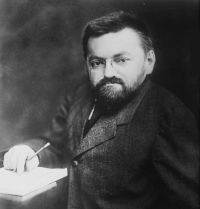
Charles Proteus Steinmetz

Charles Proteus Steinmetz

Summary

Portrait of Charles Proteus Steinmetz Charles Proteus Steinmetz Elementary lectures on electric discharges… (1911)

Just as electrical transients may, under certain conditions, rise to destructive values; so transients of other forms of energy may become destructive, or may require serious consideration, as, for instance, is the case in governing high-head water powers. The column of water in the supply pipe represents a considerable amount of stored mechanical energy, when flowing at velocity, under load. If, then, full load is suddenly thrown off, it is not possible to suddenly stop the flow of water, since a rapid stopping would lead to a pressure transient of destructive value, that is, burst the pipe.
Source: Wikisource

Portrait of Charles Proteus Steinmetz Charles Proteus Steinmetz Elementary lectures on electric discharges… (1911)

The consideration of the electric power in generator, line, and load does not represent the entire phenomenon. While electric power flows over the line A , there is a magnetic field surrounding the line conductors, and an electrostatic field issuing from the line conductors. The magnetic field and the electrostatic or “dielectric” field represent stored energy. Thus, during the permanent conditions of the flow of power through the circuit Fig. 3, there is electric energy stored in the space surrounding the line conductors.
Source: Wikisource

Portrait of Charles Proteus Steinmetz Charles Proteus Steinmetz Elementary lectures on electric discharges… (1911)

Thus, when we start the motors propelling an electric car, a transient period, of acceleration, appears between the previous permanent condition of standstill and the final permanent condition of constant-speed running; when we shut off the motors, the permanent condition of standstill is not reached instantly, but a transient condition of deceleration intervenes.
Source: Wikisource

Get perspective with Kwize: daily news enlightened by great literature