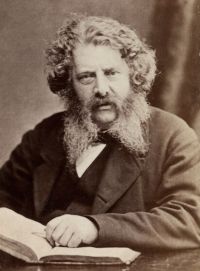
William John Macquorn Rankine

William John Macquorn Rankine

Summary

Portrait of William John Macquorn Rankine William John Macquorn Rankine Outlines of the Science of Energetics (1855)

In this brief essay, it has not been attempted to do more than to give an outline of some of the more obvious principles of the science of energetics, or the abstract theory of physical phenomena in general; a science to which the maxim, true of all science, is specially applicable— that its subjects are boundless, and that they never can, by human labours, be exhausted, nor the science brought to perfection.
Source: Wikisource

Portrait of William John Macquorn Rankine William John Macquorn Rankine Outlines of the Science of Energetics (1855)

The term "energy" comprehends every state of a substance which constitutes a capacity for performing work. Quantities of energy are measured by the quantities of work which they constitute the means of performing.
"Actual energy" comprehends those kinds of capacity for performing work which consist in particular states of each part of a substance, how small soever; that is, in an absolute accident, such as heat, light, electric current, vis-viva. Actual energy is essentially positive.
Source: Wikisource

Portrait of William John Macquorn Rankine William John Macquorn Rankine Outlines of the Science of Energetics (1855)

An essential distinction exists between two stages in the process of advancing our knowledge of the laws of physical phenomena; the first stage consists in observing the relations of phenomena, whether of such as occur in the ordinary course of nature, or of such as are artificially produced in experimental investigations, and in expressing the relations so observed by propositions called formal laws. The second stage consists in reducing the formal laws of an entire class of phenomena to the form of a science;
Source: Wikisource

Get perspective with Kwize: daily news enlightened by great literature