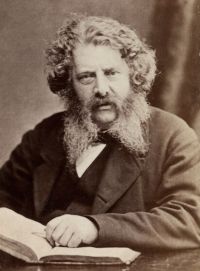
William John Macquorn Rankine

Biographical details

Portrait of William John Macquorn Rankine William John Macquorn Rankine Outlines of the Science of Energetics (1855)

For axioms, to express the laws of those more extensive classes of phenomena, let us frame propositions comprehending as particular cases, the laws of the particular classes of phenomena comprehended under the more extensive classes. So shall we arrive at a body of principles, applicable to physical phenomena in general, and which being framed by induction from facts alone, will be free from the uncertainty which must always attach even to those mechanical hypotheses whose consequences are most fully confirmed by experiment.
Source: Wikisource

Portrait of William John Macquorn Rankine William John Macquorn Rankine Outlines of the Science of Energetics (1855)

The term "energy" comprehends every state of a substance which constitutes a capacity for performing work. Quantities of energy are measured by the quantities of work which they constitute the means of performing.
"Actual energy" comprehends those kinds of capacity for performing work which consist in particular states of each part of a substance, how small soever; that is, in an absolute accident, such as heat, light, electric current, vis-viva. Actual energy is essentially positive.
Source: Wikisource

Portrait of William John Macquorn Rankine William John Macquorn Rankine Outlines of the Science of Energetics (1855)

Work. "Work" is the variation of an accident by an effort, and is a term comprehending all phenomena in which physical change takes place. Quantity of work is measured by the product of the variation of the passive accident by the magnitude of the effort, when this is constant; or by the integral of the effort, with respect to the passive accident, when the effort is variable.
Source: Wikisource

Get perspective with Kwize: daily news enlightened by great literature