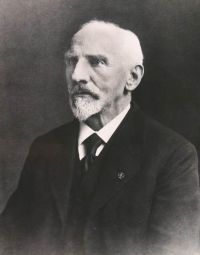
Christiaan Snouck Hurgronje

Christiaan Snouck Hurgronje

Summary

Portrait of Christiaan Snouck Hurgronje Christiaan Snouck Hurgronje The Holy War, "Made in Germany"… (1915)

Indeed, in Islâm it is only necessary to remove the mediæval restriction of the right to complete political existence, which was limited to members of the same community, and to expand the idea of the community to one embracing the whole world, in order to assure absolute world-peace, an absolute command of the divine law. To modern states which have Mohammedans as subjects, protégés, or allies, the beautiful task is reserved of educating these and themselves at the same time to this high conception of human society
Source: Wikisource

Portrait of Christiaan Snouck Hurgronje Christiaan Snouck Hurgronje The Holy War, "Made in Germany"… (1915)

The Caliph, the lieutenant of Allah's Messenger, and the jzhâd, the holy war against the whole world outside Islâm: with those two names was indissolubly connected the remembrance of those two brilliant centuries in which the course of circumstances seemed to justify the Mohammedan ambition for world-dominion. Whatever disappeared in reality survived in legend; the worship of the shadow-Caliphs of Bagdad made it easier for many Mohammedans to forget the failure of their political ideal.
Source: Wikisource

Portrait of Christiaan Snouck Hurgronje Christiaan Snouck Hurgronje The Holy War, "Made in Germany"… (1915)

The whole set of laws which, according to Islâm, should regulate the relations between believers and unbelievers, is the most consequent elaboration imaginable of a mixture of religion and of politics in their mediæval form. That he who possesses material power should also dominate the mind is accepted as a matter of course; the possibility that adherents of different religions could live together as citizens of the same state and with equal rights is excluded.
Source: Wikisource

Get perspective with Kwize: daily news enlightened by great literature