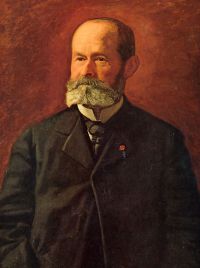
Daniel G. Brinton

Daniel G. Brinton

Summary

Portrait of Daniel G. Brinton Daniel G. Brinton The American Race

The Antis or Campas, who perhaps occupy the original home of the stock, own as the centre of their domain the table-land known as El Gran Pajonal, or the Great Grass Field, bounded by the rivers Ucayali, Pachitea and Perene. Their hue is a bistre and their habits wild; some slight tillage is carried on, and the women spin and weave the wild cotton into coarse garments. The taming of animals is one of their arts, and around their huts are seen monkeys, parrots, peccaries and tapirs.
Source: Gutenberg

Portrait of Daniel G. Brinton Daniel G. Brinton The American Race

The linguistic classification of the American tribes is at present imperfect in many regions on account of the incomplete information about their tongues. A proper comparison of languages or dialects includes not merely the vocabulary, but the grammatical forms and the phonetic variations which the vocal elements undergo in passing from one form of speech to another. In some respects, the morphology is more indicative of relationship than the lexicon of tongues; and it is in these grammatical aspects that we are peculiarly poorly off when we approach American dialects.
Source: Gutenberg

Portrait of Daniel G. Brinton Daniel G. Brinton The American Race

Of course it would not be correct to suppose that the earliest inhabitants of the continent presented the physical traits which mark the race to-day. Racial peculiarities are slowly developed in certain “areas of characterization,” but once fixed are indelible. Can we discover the whereabouts of the area which impressed upon primitive American man—an immigrant, as we have learned, from another hemisphere—those corporeal changes which set him over against his fellows as an independent race?
Source: Gutenberg

Get perspective with Kwize: daily news enlightened by great literature