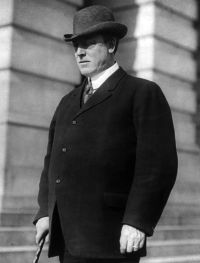
Duncan E. McKinlay

Duncan E. McKinlay

Summary

Portrait of Duncan E. McKinlay Duncan E. McKinlay The Panama Canal

No doubt the French used the best machinery that could be obtained at that time, but that was thirty years ago, and the progress of the world, particularly in the use of labor-saving machinery, is nowhere more thoroughly demonstrated than on the Isthmus of Panama by a comparison of the old French machinery with that assembled by the American engineers. There are piles of French locomotives that today are absolutely worthless, not because the machinery itself is defective, but because of their feeble power.
Source: Gutenberg

Portrait of Duncan E. McKinlay Duncan E. McKinlay The Panama Canal

The completion of the canal, while a world event, will, of course, be of peculiar significance and importance to that portion of the globe which borders on the Pacific Ocean. Countries, islands, coasts and States that for centuries have been isolated and far distant by water routes from the centers of population of Europe and Eastern United States, will be brought thousands of miles nearer to, and consequently, into more intimate social, industrial and business relations with the more highly organized governments of Europe and America.
Source: Gutenberg

Portrait of Duncan E. McKinlay Duncan E. McKinlay The Panama Canal

A great nation such as the United States could not contemplate becoming the tenant of any other country under the sun, much less a feeble republic of Central America. The dignity of the United States required absolute sovereignty over any territory through which the American Nation might decide to construct an isthmian canal. Absolute sovereignty over an isthmian canal, however, on the part of the United States had been waived by the terms of the Clayton-Bulwer treaty entered into with Great Britain a half century before.
Source: Gutenberg

Get perspective with Kwize: daily news enlightened by great literature