Summary

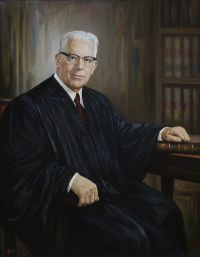
Portrait of Earl Warren Earl Warren Wood v. Georgia — Opinion of the Court

The test for punishing attempts to influence a grand or petit jury should be less rather than more stringent.
I cannot agree with the Court that petitioner's statements would have been likely to affect the outcome of the investigation 'only if the charge was so manifestly unjust that it could not stand inspection.' 370 U.S., p. 391, 82 S.Ct., p. 1373. This is to discredit the persuasiveness of argument, which the Court purports to value so highly. Any expression of opinion on the merits of a pending judicial proceeding is likely to have an impact on deliberations.
Source: Wikisource

Portrait of Earl Warren Earl Warren Wood v. Georgia — Opinion of the Court

Thus we have simply been told, as a matter of law without factual support, that if a State is unable to punish persons for expressing their views on matters of great public importance when those matters are being considered in an investigation by the grand jury, a clear and present danger to the administration of justice will be created. We find no such danger in the record before us. The type of 'danger' evidenced by the record is precisely one of the types of activity envisioned by the Founders in presenting the First Amendment for ratification.
Source: Wikisource

Portrait of Earl Warren Earl Warren Wood v. Georgia — Opinion of the Court

While courts have continuously had the authority and power to maintain order in their courtrooms and to assure litigants a fair trial, the exercise of that bare contempt power is not what is questioned in this case. Here it is asserted that the exercise of the contempt power, to commit a person to jail for an utterance out of the presence of the court, has abridged the accused's liberty of free expression.
Source: Wikisource

Get perspective with Kwize: daily news enlightened by great literature