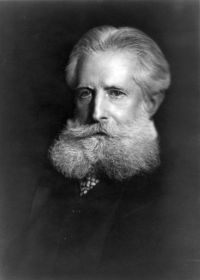
Edmund Clarence Stedman

Edmund Clarence Stedman

Summary

Portrait of Edmund Clarence Stedman Edmund Clarence Stedman Appletons' Cyclopædia of American Biography (1889)

He began with much zest, in 1863, his career as a novelist, laying his plots and scenes in his own country. “Hannah Thurston” (1863) , whose heroine is a Pennsylvania Quakeress, was followed by “John Godfrey's Fortunes” (1864) ; “The Story of Kennett” (1866) ; “Joseph and his Friend” (1870) ; and “Beauty and the Beast, and Tales of Home” (1872) . “The Story of Kennett” is the most complete as a work of art. But it was as a poet that Taylor exerted all his powers and hoped to be remembered, and some of his verse reflects his highest creative mood.
Source: Wikisource

Portrait of Edmund Clarence Stedman Edmund Clarence Stedman Appletons' Cyclopædia of American Biography (1889)

When left for a time in sole charge, he was influential, as the files of the state department show, in determining Russia to extend her sympathy and active friendship to the U. S. government. Resigning his office in 1863, he visited Gotha, where he obtained unusual facilities for his study of the life and writings of Goethe. After the loss of a brother, Col. Frederic Taylor, at Gettysburg, he went home in the autumn of 1863 and resumed his professional labors. In 1867 the Taylors revisited Switzerland and Italy, and the poet was brought near to death by an attack of Roman fever.
Source: Wikisource

Portrait of Edmund Clarence Stedman Edmund Clarence Stedman Appletons' Cyclopædia of American Biography (1889)

After reaching his majority he always signed his name Bayard Taylor. His boyhood was passed near Kennett on a farm. He learned to read at four, began to write early, and from his twelfth year wrote “poems, novels, historical essays, but chiefly poems.” At the age of fourteen he studied Latin and French, and Spanish not long afterward. In 1837 the family removed to West Chester. There, and at Unionville, the youth had five years of high-school training. His first printed poem was contributed in 1841 to the “Saturday Evening Post,” Philadelphia.
Source: Wikisource

Get perspective with Kwize: daily news enlightened by great literature