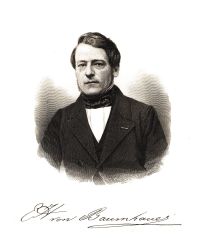
Eduard Hendrik von Baumhauer

Eduard Hendrik von Baumhauer

Summary

Portrait of Eduard Hendrik von Baumhauer Eduard Hendrik von Baumhauer Popular Science Monthly (1878)

Still, I have often seen heavy oak-piles where the creosote had entered into the very heart.
“Creosoted wood is also used in our country for railway-sleepers and tramways, and everywhere with the best results. They last four or five times longer than when unprepared, while experience shows that wood treated with sulphate of copper or chloride of zinc (Burnettizing) is neither protected from the teredo nor the influences of humidity and of the atmosphere.”
Source: Wikisource

Portrait of Eduard Hendrik von Baumhauer Eduard Hendrik von Baumhauer Popular Science Monthly (1878)

Hence it is clear, after the description which we have given above, that if the large adductor muscle contracts, the denticles of the anterior or spiral part of the valve cut the wood; if, on the contrary, the small adductor muscle is shortened, it is the middle part of the valve which undergoes a movement of rotation, and the teeth which it bears are set at work. Thus, then, whether the two muscles contract simultaneously or one by one, the woody cells are cut by successive incisions, which would divide them into small quadrangular pieces, if there be no rending of the fibres.
Source: Wikisource

Portrait of Eduard Hendrik von Baumhauer Eduard Hendrik von Baumhauer Popular Science Monthly (1878)

The results of these experiments strongly convinced the commission that no exterior application of any nature whatever, or modification of the surface merely, would give any efficacious guarantee of protection against the teredo. Even supposing that one or another of these means would prevent the young teredos from attaching themselves to the wood, yet the constant friction of the water or ice, or any accident, might break the surface of the wood sufficiently to give access to the teredo.
Source: Wikisource

Get perspective with Kwize: daily news enlightened by great literature