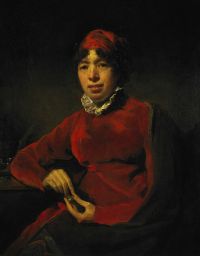
Elizabeth Hamilton

Elizabeth Hamilton

Summary

Portrait of Elizabeth Hamilton Elizabeth Hamilton 1911 Encyclopædia Britannica (1911)

Consciousness, itself a conditioned phenomenon, must derive from or depend on some different thing prior to or behind material phenomena. Curiously enough, however, Hamilton does not explain how it comes about that God, who in the terms of the analogy bears to the conditioned mind the relation which the conditioned mind bears to its objects, can Himself be unconditioned. He can be regarded only as related to consciousness, and in so far is, therefore, not absolute or unconditioned. Thus the very principles of Hamilton’s philosophy are apparently violated in his theological argument.
Source: Wikisource

Portrait of Elizabeth Hamilton Elizabeth Hamilton 1911 Encyclopædia Britannica (1911)

By far his most important work was his “Philosophy of the Unconditioned,” the development of the principle that for the human finite mind there can be no knowledge of the Infinite. The basis of his whole argument is the thesis, “To think is to condition.” Deeply impressed with Kant’s antithesis between subject and object, the knowing and the known, Hamilton laid down the principle that every object is known only in virtue of its relations to other objects (see Relativity of Knowledge) .
Source: Wikisource

Portrait of Elizabeth Hamilton Elizabeth Hamilton 1911 Encyclopædia Britannica (1911)

In logic, Hamilton is known chiefly as the inventor of the doctrine of the “quantification of the predicate,” i.e. that the judgment “All A is B” should really mean “All A is all B,” whereas the ordinary universal proposition should be stated “All A is some B.” This view, which was supported by Stanley Jevons, is fundamentally at fault since it implies that the predicate is thought of in its extension; in point of fact when a judgment is made, e.g. about men, that they are mortal (“All men are mortal”) , the intention is to attribute a quality (i.e. the predicate is used in connotation) .
Source: Wikisource

Get perspective with Kwize: daily news enlightened by great literature