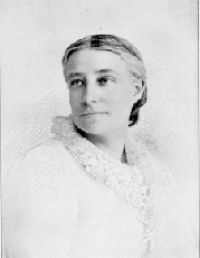
Elizabeth Stuart Phelps

Elizabeth Stuart Phelps

Summary

Portrait of Elizabeth Stuart Phelps Elizabeth Stuart Phelps A Chariot of Fire

The automobile, flying through them, encountered no answering sign of life. Both men had ceased to speak. Awe fell upon them, as if in the presence of more than natural things. Once it seemed to Dryver as if he saw a boy running beside the machine—a little fellow, white, like a spirit, and, like a spirit, silent. Chester's hands had stiffened to the throttle; his face had the stern rigidity of those on whom life or human souls absolutely depend. Neither man spoke now aloud.
To himself Jacob Dryver repeated: "It's Batty! It's my Batty!"
Source: Gutenberg

Portrait of Elizabeth Stuart Phelps Elizabeth Stuart Phelps A Chariot of Fire

She had read of angels in the Bible. She had noticed, indeed, that they were men angels. But she had never heard of one in a rubber touring-coat, drenched from head to foot with fog, spattered from foot to head with mud, and with a wedding-ring upon his fine hand.
Jacob Dryver began: "Sir! The God of Everlastin'—" but he sobbed so that he could not finish what he would have said. So Chester went out and oiled the Aurora, opened the throttle, and started off again, and dashed through the rude streets of Gloucester to her summer shore.
Source: Gutenberg

Portrait of Elizabeth Stuart Phelps Elizabeth Stuart Phelps A Chariot of Fire

Mrs. Chester had wished to duplicate for the quarryman's boy the Christmas gifts of her own child (such had been her pretty fancy) , but Batty was quite a lad—ten years old; and Bert, like a spoiled collie, was yet a baby, and likely to remain so for some time to come. So the mother contented herself, perforce, with less intimate remembrances. Once, when she had packed a box of miracles—toys and books, clothes and candy—she thrust it from her with a cry: "They would never touch these—if they knew! Hurlburt! Hurlburt! don't you think they ought to know?"
Source: Gutenberg

Get perspective with Kwize: daily news enlightened by great literature