Summary

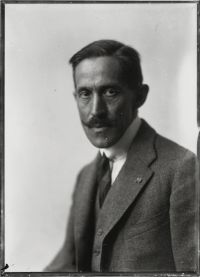
Portrait of Emil Mayer Emil Mayer Bromoil printing and bromoil transfer (1923)

To the trained eye the technique of such photo-sketches is abominable, for the contrast between the inimitable detail of the head and the perfectly blank background is so great that it cannot be bridged over by the effort to imitate the manner of an etching. On the other hand, such problems can be solved in an artistic way with our process, for the head may always be produced in a rather coarse grain, so that it dovetails harmoniously into the sketchily treated surroundings.
Source: Gutenberg

Portrait of Emil Mayer Emil Mayer Bromoil printing and bromoil transfer (1923)

The danger here is that one is tempted by the vigor of some part of the picture to make the other parts also as strong in color, until by such continued action the print is immersed in the deepest gloom, which becomes still more gloomy after defatting the finished print. Such excess must be avoided as a rule. Experience and taste soon teach one to hit the happy mean.
The first, delicate and general application of ink, which may be considered as a guide print, is in many cases somewhat wearisome, especially when the picture has large areas of rich, deep shadows.
Source: Gutenberg

Portrait of Emil Mayer Emil Mayer Bromoil printing and bromoil transfer (1923)

The unlimited freedom which it offers will certainly in the course of time produce many excesses in color. For this, however, we should condemn, not the process itself, but those who have abused it. In general it will be as well not to approach too closely the actual colors of the objects represented, but to work for the attainment of artistic effects. We must, however, in any case avoid even the most remote imitation of the painter; we cannot arrive at the solution of the problem of natural colors on paper by the polychrome bromoil process.
Source: Gutenberg

Get perspective with Kwize: daily news enlightened by great literature