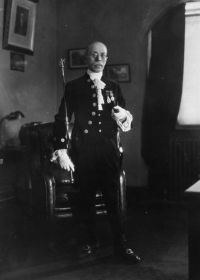
Ernest J. Chambers

Ernest J. Chambers

Summary

Portrait of Ernest J. Chambers Ernest J. Chambers The Unexploited West

Away on Great Slave lake a half-breed had told me of the beauties of Fort Vermilion as a farming country, and had explained that all the good things of the world grew there freely, so that I was prepared for the sight of wheat and barley fields, which had this year produced a more abundant harvest than usual; potatoes and other vegetables were growing luxuriously; cattle and horses were fattening on the rich prairie grass, and it seemed that there was little to be gained by leaving such a fertile spot in the face of the winter that would soon be upon us.
Source: Gutenberg

Portrait of Ernest J. Chambers Ernest J. Chambers The Unexploited West

From our position, and embracing an angle of fully one hundred and thirty degrees, or, in other words, from the northwest round to south, a boundless and nearly level expanse of country could be taken in at a glance, the only breaks being the great valleys of Peace and Smoky rivers, than which nothing we had ever seen could be more beautiful, the former especially, in its magnitude and depth, surpassing all we had anticipated.
Source: Gutenberg

Portrait of Ernest J. Chambers Ernest J. Chambers The Unexploited West

The very name of this river suggests the historic fact that the natives of the country deliberately and habitually set the woods on fire, their object being to attract the deer which are known to be fond of the sweet grass which springs from the ashes of a fire swept surface. The result is that large tracts of country are denuded of their rich first growth of trees, and young forests are just coming into the middle stages of growth, while many of the hills stand bald and bare, giving silent evidence of the severity of successive visitations of the devouring flame.
Source: Gutenberg

Get perspective with Kwize: daily news enlightened by great literature