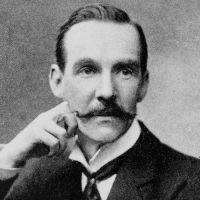
Ernest William Hobson

Ernest William Hobson

Summary

Portrait of Ernest William Hobson Ernest William Hobson Encyclopædia Britannica, Ninth Edition (1888)

He used the notation sin, tan, sec for the sine, tangent, and secant of an arc. In the second half of the 17th century the theory of infinite series was developed by Wallis, Gregory, Mercator, and afterwards by Newton and Leibnitz. In the Analysis per æquationes numero terminorum infinitas, which was written before 1669, Newton gave the series for the arc in powers of its sine; from this he obtained the series for the sine and cosine in powers of the arc; but these series were given in such a form that the law of the formation of the coefficients was hidden.
Source: Wikisource

Portrait of Ernest William Hobson Ernest William Hobson Encyclopædia Britannica, Ninth Edition (1888)

Since any plane tri angle can be divided into right-angled triangles, the solution of all plane triangles can be reduced to that of right-angled triangles; moreover, according to the theory of similar triangles, the ratios between pairs of sides of a right-angled triangle depend only upon the magnitude of the acute angles of the triangle, and may therefore be regarded as functions of either of these angles. The primary object of trigonometry, therefore, requires a classification and numerical tabulation of these functions of an angular magnitude
Source: Wikisource

Portrait of Ernest William Hobson Ernest William Hobson Encyclopædia Britannica, Ninth Edition (1888)

If a be the numerical value of the smallest angle of which OP and OA are boundaries, we see that, since these straight lines also bound all the angles 2nir + a, where n is any positive or negative integer, the sines and cosines of all these angles are the same as the sine and cosine of a. Hence the sine of any angle 2nir + a is positive if a is between and tr and negative if a is between ir and 2ir, and the cosine of the same angle is positive if o is between and ir or fir and 2ir and negative if a is between ir and fir.
Source: Wikisource

Get perspective with Kwize: daily news enlightened by great literature