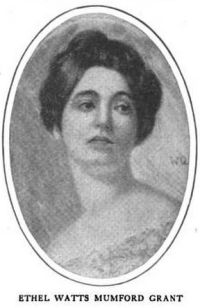
Ethel Watts Mumford

Ethel Watts Mumford

Bounty (1917)

Summary

Portrait of Ethel Watts Mumford Ethel Watts Mumford Bounty (1917)

Late October always saw him back in Tomantoul, the same gaunt, beetle-browed, large featured eccentric that had wandered south in May time. These unsettled habits placed him outside the realm of the respectable, on a par with gypsies and tinkers. Few, indeed, were his companions, yet he was never lonely while he had his violin. That it was a genuine Guardinini meant nothing to his compatriots, to whom the make of a pipe was all-important; to them it was a fiddle, nothing more. To Allistaer it was a child, a familiar, a beloved, second only in importance to his dour Scotch honor.
Source: Wikisource

Portrait of Ethel Watts Mumford Ethel Watts Mumford Bounty (1917)

Outside the wind of the rising storm shrieked and whined. The distant rush of the flooding river came to his ears in the dreary lulls; then the queer, minor hoot of the south-bound train from Elgin warned him of the hour—seven. The red glow had died down in the stove, black dark occupied the carpenter's shop from wall to wall and floor to ceiling—and its old companion, cold, fingered at casement and door, seeking entry.
Allistaer rose stiffly from the bench. He had seen a way, the only way, and he was ready to take it. Once his decision made, all else was simple.
Source: Wikisource

Portrait of Ethel Watts Mumford Ethel Watts Mumford Bounty (1917)

Presently the violin began a thin, eery, aching melody. Forgotten were the eager, impish children nudging each other on the whittled forms. Gone were the yellow pine walls of the carpenter's shop; even the steaming Scotch-and-water ceased to exist. Aye! that was it, the tune that had come to him out on the moors above Tomantoul that last day, when Tammas had declared his ambition and received its quietus.
Source: Wikisource

Get perspective with Kwize: daily news enlightened by great literature