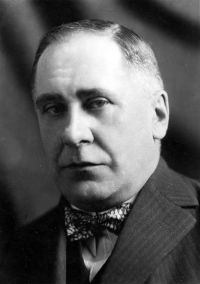
Ferdynand Antoni Ossendowski

Ferdynand Antoni Ossendowski

Summary

Portrait of Ferdynand Antoni Ossendowski Ferdynand Antoni Ossendowski From President to Prison (1925)

Suddenly, during the worst hours of my despair, a bright ray seemed to penetrate right into my soul, while an incomprehensible and unexpected serenity spread its influence over me. I could not understand or guess what the reason might be; I knew only that something had definitely healed and calmed me.
A week later I was called to the prison office, where I saw a woman in a black gown; but, as the light was poor, I did not recognize her as anyone I knew.
"Your mother has come to see you," said the Commandant in a low voice. "I shall leave you to yourselves."
Source: Wikisource

Portrait of Ferdynand Antoni Ossendowski Ferdynand Antoni Ossendowski From President to Prison (1925)

I lay down with wide-open eyes, thinking of nothing but always feeling the persistent stare of the soldier. Soon I was conscious of the fact that I was really thinking of nothing at all and began to search for the reason of this unusual state of my mind. The answer was not far to seek. Instinctively my whole organism was feeling the uncertainty of each new moment. I had been thrown into this military prison, the most relentless and most stern of all, in a disgusting hole of a cell with frozen, damp walls and with a miniature barred window covered with planks.
Source: Wikisource

Portrait of Ferdynand Antoni Ossendowski Ferdynand Antoni Ossendowski From President to Prison (1925)

Soon the town forgot about this bag, save the two whose lives it changed—a woman in black, who visited the grave of the murdered cashier, and the stupid soldier who spent a year in prison for his careless performance of duty. But it is always this way in the world: the tears of despair of a single individual or of many do not make a continuing discord or a lasting disturbance in the social life, which after a moment moves on and continues its way indifferent to, and regardless of, the sufferings or emotions of the few. This is the law of human nature, dominated by the struggle for existence.
Source: Wikisource

Get perspective with Kwize: daily news enlightened by great literature