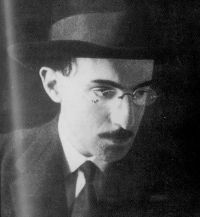
Fernando Pessoa

Fernando Pessoa

Summary

Portrait of Fernando Pessoa Fernando Pessoa Antinous: A Poem (1918)

Love to be more love than love can be, «Kiss
My eyelids till my closed eyes seem to guess
The kiss they feel laid in my heart's breast-bed.»
O Hadrian, what shall now thy cold life be?
What boots it to be emperor over all?
His absence o'er thy visible empery
Throws a dim pall.
Now are thy nights widowed of love and kisses,
Now are thy days robbed of the night's awaiting,
Now are thy lips purposeless and thy blisses
No longer of the size of thy life, mating
Thy empire with thy love's bold tendernesses.
Now are thy doors closed upon beauty and joy.
Source: Gutenberg

Portrait of Fernando Pessoa Fernando Pessoa Antinous: A Poem (1918)

«The end of days, when Jove is born again,
And Ganymede again pour at his feast,
Shall see our dual soul from death released
And recreated unto love, joy, pain,
Life—all the beauty and the vice and lust,
All the diviner side of flesh, flesh-staged.
And, if our very memory wore to dust,
By the giant race of the end of ages must
Our dual presence once again be raised.»
It rained still. But slow-treading night came in
Closing the weary eyelids of each sense.
The very consciousness of self and soul
Grew, like a landscape through dim raining, dim.
Source: Gutenberg

Portrait of Fernando Pessoa Fernando Pessoa Antinous: A Poem (1918)

He rises, mad, and looks upon his lover,
That now can love nothing but what none know.
Then his cold lips run all the body over—
His lips that scarce remember their warmth, now
So blent with feeling the death they behold;
And so ice-senseless are his lips that, lo!,
He scarce tastes death from the dead body's cold,
But it seems both are dead or living both
And love is still the Presence and the Mover.
Then his lips cease on the other lips' cold sloth.
But there the wanting breath reminds his lips
That between him and his boy-love the mist
That comes out of the gods has crept.
Source: Gutenberg

Get perspective with Kwize: daily news enlightened by great literature