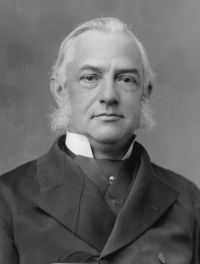
Friedrich Max Müller

Friedrich Max Müller

Summary

Portrait of Friedrich Max Müller Friedrich Max Müller,  Popular Science Monthly (1875)

“ In the first place, I would observe that the presence of only thirty-four ribs in an equine race, whether ancient or modern, would not be by any means abnormal, or contrary to the laws of Nature; for it is fully agreed now that the number of these bones is far from being constant in our present horses. Indeed, Chauveau remarks as follows on the number of ribs in the horse: ‘We reckon for each lateral half of the thorax eighteen ribs. Not unfrequently we find nineteen, with an equal number of dorsal vertebræ in well-formed horses; but, then, most usually there are only five lumbar vertebræ.’ ”
Source: Wikisource

Portrait of Friedrich Max Müller Friedrich Max Müller,  Popular Science Monthly (1880)

“ Hence Europe may have been inhabited by only two races before the entrance of the Indo-Europeans, which latter is coincident with the appearance of the Etruscans and Celts, viz., by the Basques and Ligurians—a people of unknown ethnological character in the south, and the Upper Asiatic stems in the north. This settlement of the Upper Asiatic race in Europe, long before the immigration of the Indo-Europeans, presumes a migration of the former in the earliest dawn of antiquity.
In our opinion, it was this race which first gave the migratory impulse to the men inhabiting the Old World.
”
Source: Wikisource

Portrait of Friedrich Max Müller Friedrich Max Müller,  Popular Science Monthly (1880)

“ If we regard the Indo-Europeans as neighbors of the Upper Asiatics, and the Semitic and Hamitic peoples next to them, we can understand how in consequence of a pressure of the Upper Asiatics on the Indo-Europeans these must again impinge upon the Semitic and Hamitic race. Whereas the latter were pushed toward Africa, where they imparted their migratory motion to the autochthonous races, as described above, the Semitic pressed into the seats occupied before by the Hamites, and allowed the Indo-Europeans room to expand unhindered east and west. ”
Source: Wikisource

Get perspective with Kwize: daily news enlightened by great literature