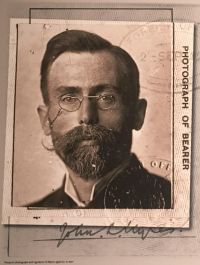
John Linton Myres

John Linton Myres

Summary

Portrait of John Linton Myres John Linton Myres 1911 Encyclopædia Britannica (1911)

Since his time the anthropological researches of Broca, Thurnam and Davis, Huxley, Busk, Beddoe, Virchow, Tubino and others have proved the existence in Europe, from Neolithic times, of a race, small of stature, with long or oval skulls, and accustomed to bury their dead in tombs. Their remains have been found in Belgium and France, in Britain, Germany and Denmark, as well as in Spain; and they bear a close resemblance to a type which is common among the Basques as well as all over the Iberian peninsula.
Source: Wikisource

Portrait of John Linton Myres John Linton Myres 1911 Encyclopædia Britannica (1911)

In the 5th century the name “Ionian” was already falling into discredit. Causes of this were (1) the peace-loving luxury (born of commercial wealth and contact with Oriental life) of the great Ionian cities of Asia; (2) the tameness with which they submitted first to Lydia and to Persia, then to Athenian pretensions, then to Sparta, and finally to Persia again; (3) the decadence and downfall of Athens, which still counted as Ionian and had claimed (since Solon’s time) seniority among “Ionian” states.
Source: Wikisource

Portrait of John Linton Myres John Linton Myres 1911 Encyclopædia Britannica (1911)

M. d’Arbois de Jubainville, for example (Les Premiers habitants de l’Europe, Paris, 1877) , maintained that besides possessing Spain, Gaul, Italy and the British Isles, “Iberian” peoples penetrated into the Balkan peninsula, and occupied a part of northern Africa, Corsica and Sardinia; and it is now generally accepted that a race with fairly uniform characteristics was at one time in possession of the south of France (or at least of Aquitania) , the whole of Spain from the Pyrenees to the straits, the Canary Islands (the Guanches) a part of northern Africa and Corsica.
Source: Wikisource

Get perspective with Kwize: daily news enlightened by great literature