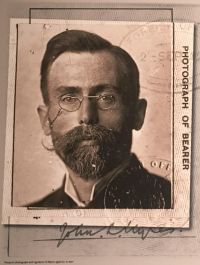
John Linton Myres

Biographical details

Portrait of John Linton Myres John Linton Myres,  1911 Encyclopædia Britannica, Volume 8… (1911)

“ Language is no better guide, for it is not clear that the Dorian dialect is that of the most recent conquerors, and not rather that of the conquered Achaean inhabitants of southern Greece; in any case it presents no such affinities with any non-Hellenic speech as would serve to trace its origin. Even in northern and west-central Greece, all vestige of any former prevalence has been obliterated by the spread of “Aeolic” dialects akin to those of Thessaly and Boeotia ”
Source: Wikisource

Portrait of John Linton Myres John Linton Myres,  1911 Encyclopædia Britannica, Volume 9… (1911)

“ In spite of its distance from the chief centres of Greek thought and action, and the barbarian repute of its inhabitants, Epirus was believed to have exerted at an early period no small influence on Greece, by means more especially of the oracle of Dodona. Aristotle even placed in Epirus the original home of the Hellenes. But in historic times its part in Greek history is mainly passive. The states of Greece proper founded a number of colonies on its coast, which formed stepping-stones towards the Adriatic and the West. ”
Source: Wikisource

Portrait of John Linton Myres John Linton Myres,  1911 Encyclopædia Britannica (1911)

“ In the 5th century the name “Ionian” was already falling into discredit. Causes of this were (1) the peace-loving luxury (born of commercial wealth and contact with Oriental life) of the great Ionian cities of Asia; (2) the tameness with which they submitted first to Lydia and to Persia, then to Athenian pretensions, then to Sparta, and finally to Persia again; (3) the decadence and downfall of Athens, which still counted as Ionian and had claimed (since Solon’s time) seniority among “Ionian” states. ”
Source: Wikisource

Get perspective with Kwize: daily news enlightened by great literature