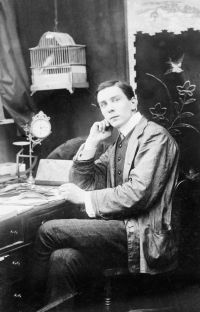
Geoffrey H. Malins

Geoffrey H. Malins

Summary

Portrait of Geoffrey H. Malins Geoffrey H. Malins How I Filmed the War

I rushed up the incline into the trench. What a sight! The whole of our front for the distance of a mile was one frightful inferno of fire. The concentration of artillery fire was terrific! Scores of star-shells shot into the air at the same moment, lighting the ground up like day, showing up the smoking, blazing mass more vividly than ever. Hundreds of shells, large and small, were bursting over our trenches simultaneously; our guns were replying on the German front with redoubled fury; the air was alive with whirling masses of metal.
Source: Gutenberg

Portrait of Geoffrey H. Malins Geoffrey H. Malins How I Filmed the War

Imagine, if you can, being in the midst of five hundred drums. At a given moment every drummer beats his drum with ever-increasing force without a fraction of a moment's respite. Add to this the most soul-splitting crash you have ever heard and the sound as of a gale of wind shrieking through the telegraph wires. It will give you a little idea of what it was like under this bombardment. It seemed to numb one's very brain. What it must have been like in the German position is beyond me to conceive. We were certainly giving Fritz a jump.
At last my camera was finished.
Source: Gutenberg

Portrait of Geoffrey H. Malins Geoffrey H. Malins How I Filmed the War

We were nearing Ypres, that shell-battered city of Flanders. White balls of smoke here and there were bursting among the ruins, showing that the Huns were still shelling it. What a frightful state the earth was in. For miles and miles around it had the appearance of a sieve, with hundreds of thousands of shell-holes, and like a beautiful green ribbon, winding away as far as the eye could see, was that wonderful yet terrible strip of ground between the lines, known as "No Man's Land."
Source: Gutenberg

Get perspective with Kwize: daily news enlightened by great literature