Summary

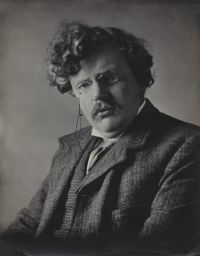
Portrait of Gilbert Keith Chesterton Gilbert Keith Chesterton Appreciations and Criticisms of the Works of Charles Dickens… (1911)

And I think there is no thought so much calculated to make one doubt death itself, to feel that sublime doubt which has created all religion -- the doubt that found death incredible. Edwin Drood may or may not have really died; but surely Dickens did not really die. Surely our real detective liveth and shall appear in the latter days of the earth. For a finished tale may give a man immortality in the light and literary sense; but an unfinished tale suggests another immortality, more essential and more strange.
Source: Wikisource

Portrait of Gilbert Keith Chesterton Gilbert Keith Chesterton Appreciations and Criticisms of the Works of Charles Dickens… (1911)

Nothing, for instance, could be cleverer as a piece of artistic mystery than the fact that Jasper, the uncle, always kept his eyes fixed on Drood's face with a dark and watchful tenderness; the thing is so told that at first we really take it as only indicating something morbid in the affection; it is only afterwards that the frightful fancy breaks upon us that it is not morbid affection but morbid antagonism.
Source: Wikisource

Portrait of Gilbert Keith Chesterton Gilbert Keith Chesterton Appreciations and Criticisms of the Works of Charles Dickens… (1911)

But Dickens, having had far too little plot in his stories previously, had far too much plot in the story he never told. Dickens dies in the act of telling, not his tenth novel, but his first news of murder. He drops down dead as he is in the act of denouncing the assassin. It is permitted to Dickens, in short, to come to a literary end as strange as his literary beginning. He began by completing the old romance of travel. He ended by inventing the new detective story.
It is as a detective story first and last that we have to consider The Mystery of Edwin Drood.
Source: Wikisource

Get perspective with Kwize: daily news enlightened by great literature