Summary

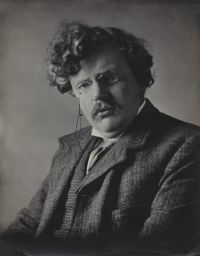
Portrait of Gilbert Keith Chesterton Gilbert Keith Chesterton,  Heretics — Chapter 3: On Mr. Rudyard Kipling and Making the World Small (1905)

“ But he does not belong to it, or to any place; and the proof of it is this, that he thinks of England as a place. The moment we are rooted in a place, the place vanishes. We live like a tree with the whole strength of the universe.
The globe-trotter lives in a smaller world than the peasant. He is always breathing, an air of locality. London is a place, to be compared to Chicago; Chicago is a place, to be compared to Timbuctoo. But Timbuctoo is not a place, since there, at least, live men who regard it as the universe, and breathe, not an air of locality, but the winds of the world.
”
Source: Wikisource

Portrait of Gilbert Keith Chesterton Gilbert Keith Chesterton,  Heretics — Chapter 3: On Mr. Rudyard Kipling and Making the World Small (1905)

“ Kipling to militarism is not the idea of courage, but the idea of discipline. There was far more courage to the square mile in the Middle Ages, when no king had a standing army, but every man had a bow or sword. But the fascination of the standing army upon Mr. Kipling is not courage, which scarcely interests him, but discipline, which is, when all is said and done, his primary theme. The modern army is not a miracle of courage; it has not enough opportunities, owing to the cowardice of everybody else. ”
Source: Wikisource

Portrait of Gilbert Keith Chesterton Gilbert Keith Chesterton,  Heretics — Chapter 3: On Mr. Rudyard Kipling and Making the World Small (1905)

“ The military man gains the civil power in proportion as the civilian loses the military virtues. And as it was in ancient Rome so it is in contemporary Europe. There never was a time when nations were more militarist. There never was a time when men were less brave. All ages and all epics have sung of arms and the man; but we have effected simultaneously the deterioration of the man and the fantastic perfection of the arms. Militarism demonstrated the decadence of Rome, and it demonstrates the decadence of Prussia.
And unconsciously Mr. Kipling has proved this, and proved it admirably.
”
Source: Wikisource

Get perspective with Kwize: daily news enlightened by great literature