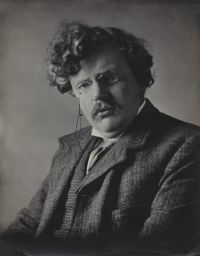
Gilbert Keith Chesterton

Gilbert Keith Chesterton

Summary

Portrait of Gilbert Keith Chesterton Gilbert Keith Chesterton What's Wrong with the World — Chapter 1 part 4 (1910)

Rather it is a fear of the past; a fear not merely of the evil in the past, but of the good in the past also. The brain breaks down under the unbearable virtue of mankind. There have been so many flaming faiths that we cannot hold; so many harsh heroisms that we cannot imitate; so many great efforts of monumental building or of military glory which seem to us at once sublime and pathetic. The future is a refuge from the fierce competition of our forefathers. The older generation, not the younger, is knocking at our door.
Source: Wikisource

Portrait of Gilbert Keith Chesterton Gilbert Keith Chesterton What's Wrong with the World — Chapter 1 part 4 (1910)

It is pleasant to play with children, especially unborn children. The future is a blank wall on which every man can write his own name as large as he likes; the past I find already covered with illegible scribbles, such as Plato, Isaiah, Shakespeare, Michael Angelo, Napoleon. I can make the future as narrow as myself; the past is obliged to be as broad and turbulent as humanity.
Source: Wikisource

Portrait of Gilbert Keith Chesterton Gilbert Keith Chesterton What's Wrong with the World — Chapter 1 part 4 (1910)

The only true free-thinker is he whose intellect is as much free from the future as from the past. He cares as little for what will be as for what has been; he cares only for what ought to be. And for my present purpose I specially insist on this abstract independence. If I am to discuss what is wrong, one of the first things that are wrong is this: the deep and silent modern assumption that past things have become impossible. There is one metaphor of which the moderns are very fond; they are always saying, "You can't put the clock back."
Source: Wikisource

Get perspective with Kwize: daily news enlightened by great literature