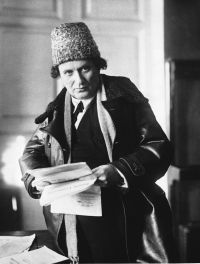
Grigory Zinoviev

Grigory Zinoviev

Summary

Portrait of Grigory Zinoviev Grigory Zinoviev Army and People (1920)

It should be kept in mind that the Commissar is the representative of a class which has conquered power and is in power for good and all; at the same time respect is due to the dignity of the man who, though issued from another sphere of life, of different breeding and education, yet comes to work with us a with a stone in his bosom, and assists with his knowledge not a party but the people, Russia—that Russia which, just now destitute, starving, crucified on every side, still is our very own, beloved Russia.
Source: Wikisource

Portrait of Grigory Zinoviev Grigory Zinoviev Army and People (1920)

Principally from the moment when civilized Europe, from the old semi-feudal, semi-servile armies, passed to the standing armies organized on the principle of obligatory universal military service, armies everywhere became flesh of the flesh and blood of the blood of the people. And every people had the army it deserved to have. And in each army, as the sun is reflected in the tiniest drop of water, came to be reflected each country's political structure and social order.
Source: Wikisource

Portrait of Grigory Zinoviev Grigory Zinoviev Army and People (1920)

How can he, fresh from the hands of a French hairdresser, find it in his heart to jeer at the poor Russian homespun-clad, sometimes half-clad peasant army, whole squads of which go barefoot?
So it is that the most monstrous treason goes on before the people's eyes. Men are clothed, fed, taught by Englishmen and Frenchmen, who cannot send their own armies to Russia, because their soldiers are sufficiently united and organized and refuse to go forth to kill Russian workers and peasants.
Source: Wikisource

Get perspective with Kwize: daily news enlightened by great literature