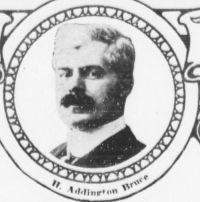
H. Addington Bruce

H. Addington Bruce

Summary

Portrait of H. Addington Bruce H. Addington Bruce Psychology and parenthood

Surely the duty of parents is plain. To set before their children from earliest infancy examples of placidity and strength of character, to educate their will no less than their intellect, to guard them as far as possible from all harmful suggestions, to love them without idolising them, to study carefully their physical as well as their mental and moral needs—in this way, and in this way alone, can safety be had against the dread evil of hysteria and allied nervous troubles.
Source: Gutenberg

Portrait of H. Addington Bruce H. Addington Bruce Psychology and parenthood

Granting that the man of genius depends for his results, as I have tried to show, on the extent to which he upbuilds and stimulates his subconscious powers by conscious observation and thought, must we not assume that he possesses, to begin with, an exceptional mental capacity? Or is favouring circumstance in his environment—the occurrence of events that make so profound an impression on his mind as to arouse a fervent longing for accomplishment—sufficient to explain him?
Source: Gutenberg

Portrait of H. Addington Bruce H. Addington Bruce Psychology and parenthood

There can be no doubt, to return for a moment to the superlatively instructive case of Karl Witte, that by all odds the greatest force in the moral development of that splendid scholar and gentleman, was the unceasing inspiration he unconsciously drew from the lives of his father and mother—from their integrity, unselfishness, patience, sincerity, and courage. Parents cannot too soon learn that, to quote a cardinal clause in the elder Witte’s educational creed:
“Our children are what we are. They are good when we are good, and bad when we are bad.
Source: Gutenberg

Get perspective with Kwize: daily news enlightened by great literature