Summary

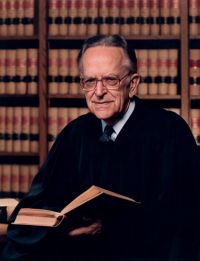
Portrait of Harry Blackmun Harry Blackmun Graham v. Richardson — Opinion of the Court

The same is true here, for in the ordinary case an alien, becoming indigent and unable to work, will be unable to live where, because of discriminatory denial of public assistance, he cannot 'secure the necessities of life, including food, clothing and shelter.' State alien residency requirements that either deny welfare benefits to noncitizens or condition them on longtime residency, equate with the assertion of a right, inconsistent with federal policy, to deny entrance and abode.
Source: Wikisource

Portrait of Harry Blackmun Harry Blackmun Graham v. Richardson — Opinion of the Court

It may legitimately attempt to limit its expenditures, whether for public assistance, public education, or any other program. But a State may not accomplish such a purpose by invidious distinctions between classes of its citizens. * * * The saving of welfare costs cannot justify an otherwise invidious classification.' 394 U.S., at 633, 89 S.Ct., at 1330.
Since an alien as well as a citizen is a 'person' for equal protection purposes, a concern for fiscal integrity is no more compelling a justification for the questioned classification in these cases than it was in Shapiro.
Source: Wikisource

Portrait of Harry Blackmun Harry Blackmun Graham v. Richardson — Opinion of the Court

In Truax the Court considered the 'reasonableness' of a state restriction on the employment of aliens in terms of its effect on the right of a lawfully admitted alien to live where he chooses:
'It must also be said that reasonable classification implies action consistent with the legitimate interests of the state, and it will not be disputed that these cannot be so broadly conceived as to bring them into hostility to exclusive Federal power. The authority to control immigration-to admit or exclude aliens-is vested solely in the Federal Government.
Source: Wikisource

Get perspective with Kwize: daily news enlightened by great literature