Summary

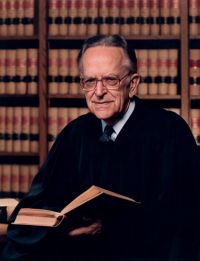
Portrait of Harry Blackmun Harry Blackmun John Doe v. John Doe — Opinion of the Court

The Act's broad provisions favoring disclosure, coupled with the specific exemptions, reveal and present the "balance" Congress has struck.
We have noted above that our focus here is on § 552 (b) (7) 's exemption from production of "records or information compiled for law enforcement purposes" to the extent that such production meets any one of six specified conditions or enumerated harms. Before it may invoke this provision, the Government has the burden of proving the existence of such a compilation for such a purpose.
Source: Wikisource

Portrait of Harry Blackmun Harry Blackmun John Doe v. John Doe — Opinion of the Court

In 1985, the office of the United States Attorney for the Eastern District of New York instituted an investigation into possible fraudulent practices by the Corporation. A subpoena was issued to the Corporation by a grand jury on February 21, 1986. It requested documents relating to the cost allocation question which was the subject of the 1978 correspondence. On September 30, 1986, the Corporation submitted to the DCAA a request under the FOIA for any documents "that are related in any way to the subject matter" of the 1978 correspondence.
Source: Wikisource

Portrait of Harry Blackmun Harry Blackmun John Doe v. John Doe — Opinion of the Court

The Court of Appeals acknowledged that compliance with the FOIA may compel disclosure of materials that ordinarily are beyond the scope of discovery in a criminal investigation, and thus may enable a potential defendant to prepare a response and construct a defense to a criminal charge. The court concluded, however, that this concern was more properly addressed to Congress.
Source: Wikisource

Get perspective with Kwize: daily news enlightened by great literature