Summary

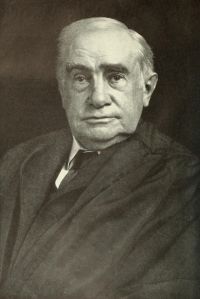
Portrait of Henry Billings Brown Henry Billings Brown Glover v. Patten — Opinion of the Court

The claim that the general bequest to her daughters, contained in Mrs. Patten's will, was an extinguishment of her debt to them, is equally unfounded. The appellants rely, in this connection, upon the general proposition that, where a debtor bequeathes to his creditor a legacy equal to or greater than the amount of his debt, it shall be presumed, in the absence of a contrary intent inferable from the will, that the legacy was intended to be in satisfaction of the debt.
Source: Wikisource

Portrait of Henry Billings Brown Henry Billings Brown Glover v. Patten — Opinion of the Court

It is a part of that duty which requires them to protect the interests of the estate. In such suits the residuary legatees are never made parties. To require it would be an intolerable burden on those who have claims on an estate in the hands of executors.' If this be the law with respect to residuary legatees, who are necessarily and directly interested in defeating every other claim against the estate, with much greater force is the rule applicable to specific legatees, who are in much less danger of being affected by the allowance of other claims.
Source: Wikisource

Portrait of Henry Billings Brown Henry Billings Brown Glover v. Patten — Opinion of the Court

It requires no argument to demonstrate that the rule has no application to a case where the bequest is a general one,-all of the property of the testator 'to be divided between them share and share alike,'-and the will is made six years before the indebtedness is liquidated. That Mrs. Patten evidently did not consider her debt to her daughter Augusta extinguished by the will is evident from the fact that she paid the amount at the time of the marriage of her daughter, and there is no reason to suppose that she intended to treat her differently from her other daughters.
Source: Wikisource

Get perspective with Kwize: daily news enlightened by great literature