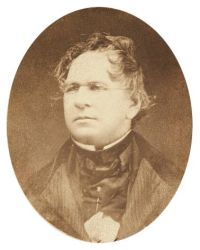
Henry Rowe Schoolcraft

Henry Rowe Schoolcraft

Summary

Portrait of Henry Rowe Schoolcraft Henry Rowe Schoolcraft Literature of the Indian Languages

The vocabularies that have been taken denote very considerable differences in the languages of the several Iroquois cantons, greater indeed, by far, than might have been expected, when it is known that these tribes understand each other. The question is one, rather of philology, than practical teaching, which we are informed is sufficiently well advanced by the present work. It is here arranged under the head of the Oneida dialect, from the known fact that Mr. Davis labors, and has long labored with that people, and the observed prevalence of the Oneida dialect, in portions of the work.
Source: Gutenberg

Portrait of Henry Rowe Schoolcraft Henry Rowe Schoolcraft Literature of the Indian Languages

It has not escaped notice, that there may be reasons for such a classification, on philological grounds. No one can have given attention to the subject without perceiving marked resemblances and affiliations, in the southern groupe of languages, such as exist between the Choctaw and the Chickesaw, and with more remoteness between the latter and the great Muscogee, or Creek family. Points of harmony in the principles of utterance, exist between all these tribes, even where coincidences in their vocabularies are reduced to but a few instances.
Source: Gutenberg

Portrait of Henry Rowe Schoolcraft Henry Rowe Schoolcraft Literature of the Indian Languages

Peter Jones, the native missionary, and is deemed by missionaries and teachers, who have devoted their attention to the language, an authentic rendering of the entire fifty chapters of the original. There is no attempt to exhibit a plan of orthography, or to employ the English alphabet in a more fixed form than is known to common writers and speakers. As the influence of the juxtaposition of consonants to vowels, and their modifications from such contact, are well known, there is little or no difficulty in arriving readily at the sounds intended by the translator to be conveyed.
Source: Gutenberg

Get perspective with Kwize: daily news enlightened by great literature