Summary

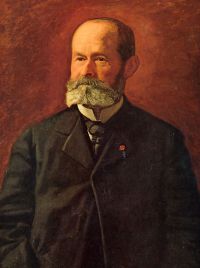
Portrait of Daniel G. Brinton Daniel G. Brinton A Record of Study in Aboriginal American Languages

James Constantine Pilling, whose admirable volumes on the bibliography of American Aboriginal Languages are familiar to all students. He had experienced the difficulty of cataloguing the articles of writers whose contributions extend over many years, and have been published in different journals, proceedings of societies and volumes, and was impressed with the advantage of an analytical list composed by the author himself.
Source: Gutenberg

Portrait of Daniel G. Brinton Daniel G. Brinton A Record of Study in Aboriginal American Languages

The Cakchiquels occupied most of the soil of Guatemala at the period of the Conquest, and their tongue was that chosen to be the “Metropolitan” language of the diocess. In (53) I gave a translation of an unpublished grammar of it, the MS. being one in the archives of the American Philosophical Society. In some respects it is superior to the grammar of Flores.
The higher culture of the tribes of Central America and Mexico gives a special interest to the study of their languages, oral [16] and written; for with some of them we find moderately well-developed methods of recording ideas.
Source: Gutenberg

Portrait of Daniel G. Brinton Daniel G. Brinton A Record of Study in Aboriginal American Languages

That some of the central subjects of poetic literature—the emotions of love and friendship—exist, and often in no low form of sentiment, among these natives, I have undertaken to show by an analysis of a number of terms expressing these feelings in five leading American linguistic stocks, the Algonkin, Nahuatl, Maya, Quechua and Tupi (No. 15) .
Following out this plan, I began in 1882 the publication of “The Library of Aboriginal American Literature.” Each volume was to contain a work composed in a native tongue by a native
Source: Gutenberg

Get perspective with Kwize: daily news enlightened by great literature