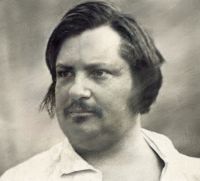
Honoré de Balzac

Honoré de Balzac

Summary

Portrait of Honoré de Balzac Honoré de Balzac The Girl with the Golden Eyes (1835)

There the mulatto, whose white eyes lit up at the sight of Paquita, took the torch from the hands of his idol, and conducted Henri to the street. He left the light under the arch, opened the door, put Henri into the carriage, and set him down on the Boulevard des Italiens with marvelous rapidity. It was as though the horses had hell-fire in their veins.
The scene was like a dream to De Marsay, but one of those dreams which, even when they fade away, leave a feeling of supernatural voluptuousness, which a man runs after for the remainder of his life. A single kiss had been enough.
Source: Wikisource

Portrait of Honoré de Balzac Honoré de Balzac The Girl with the Golden Eyes

In effect, the Parisian, with his indifference on the day for what the morrow will bring forth, lives like a child, whatever may be his age. He grumbles at everything, consoles himself for everything, jests at everything, forgets, desires, and tastes everything, seizes all with passion, quits all with indifference—his kings, his conquests, his glory, his idols of bronze or glass—as he throws away his stockings, his hats, and his fortune.
Source: Gutenberg

Portrait of Honoré de Balzac Honoré de Balzac The Girl with the Golden Eyes

The old woman received her daughter without issuing from her state of immobility, or displaying any emotion. The mother possessed in the highest degree that gravity of savage races, the impassiveness of a statue upon which all remarks are lost. Did she or did she not love her daughter? Beneath that mask every human emotion might brood—good and evil; and from this creature all might be expected. Her gaze passed slowly from her daughter’s beautiful hair, which covered her like a mantle, to the face of Henri, which she considered with an indescribable curiosity.
Source: Gutenberg

Get perspective with Kwize: daily news enlightened by great literature