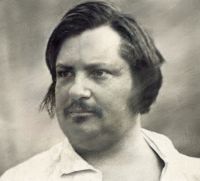
Honoré de Balzac

Honoré de Balzac

Summary

Portrait of Honoré de Balzac Honoré de Balzac The Thirteen

When a woman is very much in love, and has not seen her lover for two months, such a swift moment must be something like the phase of a dream when the eyes embrace a world that stretches away forever. Only women or young men can imagine the dull, frenzied hunger in the Duchess’s eyes. As for older men, if during the paroxysms of early passion in youth they had experience of such phenomena of nervous power; at a later day it is so completely forgotten that they deny the very existence of the luxuriant ecstasy—the only name that can be given to these wonderful intuitions.
Source: Gutenberg

Portrait of Honoré de Balzac Honoré de Balzac The Thirteen

At Paris, in the highest society of all, a woman is a woman still; she lives on incense, adulation, and honours. No beauty, however undoubted, no face, however fair, is anything without admiration. Flattery and a lover are proofs of power. And what is power without recognition? Nothing. If the prettiest of women were left alone in a corner of a drawing-room, she would droop. Put her in the very centre and summit of social grandeur, she will at once aspire to reign over all hearts—often because it is out of her power to be the happy queen of one.
Source: Gutenberg

Portrait of Honoré de Balzac Honoré de Balzac The Thirteen

Is not music, and even opera music, a sort of text, which a susceptible or poetic temper, or a sore and stricken heart, may expand as memories shall determine? If a musician must needs have the heart of a poet, must not the listener too be in a manner a poet and a lover to hear all that lies in great music? Religion, love, and music—what are they but a threefold expression of the same fact, of that craving for expansion which stirs in every noble soul. And these three forms of poetry ascend to God, in whom all passion on earth finds its end.
Source: Gutenberg

Get perspective with Kwize: daily news enlightened by great literature