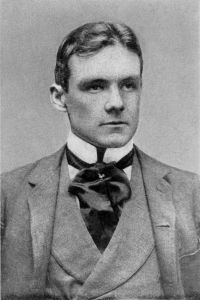
Richard Harding Davis

Richard Harding Davis

Summary

Portrait of Richard Harding Davis Richard Harding Davis About Paris

The French swells who are their escorts have cut down Chinese lanterns with their sticks, and stuck the candles inside of them on the top of their high hats with the burning tallow, and made living torches of themselves. So on they go, racing by—first a youth in evening dress, dripping with candle-grease, and then a beautiful girl in a dinner gown, with her silk and velvet opera cloak slipping from her shoulders—all singing to the music of the band, sweeping the people before them, or closing in a circle around some stately dignitary, and waltzing furiously past him to prevent his escape.
Source: Gutenberg

Portrait of Richard Harding Davis Richard Harding Davis About Paris

You cannot say you have seen the streets of Paris until you have walked them at sunrise; every one has seen them at night, but he must watch them change from night to day before he can claim to have seen them at their best. I walked under the arches of the Rue de Rivoli one morning when it was so dark that they looked like the cloisters of some great monastery, and it was impossible to believe that the empty length of the Rue Cambon had but an hour before been blocked by the blazing front of the Olympia, and before that with rows of carriages in front of the two Columbins.
Source: Gutenberg

Portrait of Richard Harding Davis Richard Harding Davis About Paris

There were a few belated cabs hugging the sidewalk, with their drivers asleep on the boxes, and a couple of gendarmes slouching together across the Place de la Concorde made the only sound of life in the whole city. The Seine lay as motionless as water in a bath-tub, and the towers of Notre Dame rising out of the mist at one end, and the round bulk of the Trocadéro bounding it at the other, seemed to limit the river to what one could see of its silent surface from the Bridge of the Deputies.
Source: Gutenberg

Get perspective with Kwize: daily news enlightened by great literature