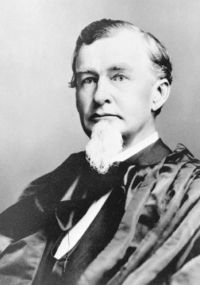
Howell Edmunds Jackson

Howell Edmunds Jackson

Summary

Portrait of Howell Edmunds Jackson Howell Edmunds Jackson Howard v. Detroit Stove Works…

The description of the invention is vague and indefinite, and is not sufficient to enable those skilled in the art to construct it without experiment so as to attain the desired result. The width of the flange is a mere matter of degree, and if at the time of the invention the proper width of the flange to accomplish the purpose desired was known, then the patentee made no invention.
Source: Wikisource

Portrait of Howell Edmunds Jackson Howell Edmunds Jackson Howard v. Detroit Stove Works…

At the date of this invention it was common to make wood-burning grates partly open and partly closed, with teeth at their ends, which serve exactly the same purpose as the teeth, D, of the patent. These grates are all used in cooking stoves, and are rectangular in form, while the Beckwith patent is circular in shape; but it cannot be maintained that there is any element of invention in making the grate fit the particular fire box of the stove to be constructed. To accomplish that end mechanical skill alone is necessary, and does not call for the exercise of inventive talent.
Source: Wikisource

Portrait of Howell Edmunds Jackson Howell Edmunds Jackson Howard v. Detroit Stove Works…

The inventor stated in his application that he had found that the expansion of the fire pot is so great without the flange that the stove proves a failure, but, with the flange cast on it at the point designated above, the joint will remain tight during the lifetime of the stove. The novelty involved in the patent consists entirely of the tapering cast-iron fire pot with the annular flange or shelf formed on its inside lower end at the point where it joins the ash pit, and upon which flange the grate rests.
Source: Wikisource

Get perspective with Kwize: daily news enlightened by great literature