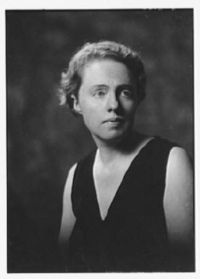
I. A. R. Wylie

I. A. R. Wylie

Summary

Portrait of I. A. R. Wylie I. A. R. Wylie The Love Story of Edwin Binns (1915)

Edwin Binns sat down on the camp bed under the slope of the roof. A candle burned on a rickety little table beside him, and its unsteady flicker accentuated the nervous quiver at the corners of the unformed mouth beneath the overwaxed mustache. He was breathing quickly, as if he had been running, and there was something sullenly exultant about him that was not attractive.
He held an unopened letter in his hand. The writing on the envelope was feminine and very neat. The Times had added the address, but the feminine handwriting dominated by its exquisiteness and character.
Source: Wikisource

Portrait of I. A. R. Wylie I. A. R. Wylie The Love Story of Edwin Binns (1915)

The neat handwriting had lost its primness. It hurried across the delicately tinted note paper in quick, unsteady lines, as if the hand that held the pen had lost its cunning.
You mustn't clear out. You must go back to the regiment—to the trenches—and prove yourself a man. I do not believe that you are a coward. You would not have written to me as you did if you had been a coward—you would have gone on pretending. But you are so young. You didn't know what death looked like—and it is harder for some to face than it is for others. If I had been Helen, I would have given you another chance.
Source: Wikisource

Portrait of I. A. R. Wylie I. A. R. Wylie The Love Story of Edwin Binns (1915)

Edwin Binns sat upright in the corner of his taxi, a sheet of note paper, covered with the delicate writing, pressed in his hand, and prayed desperately. He had not prayed in the trenches or, indeed, since his early childhood, and possibly he did not believe in prayer. But he had reached that limit of human strength when the veriest heathen dares no longer count on himself alone. For it is one thing to give up life—it is another to give up all that makes life worth living.
Source: Wikisource

Get perspective with Kwize: daily news enlightened by great literature