Summary

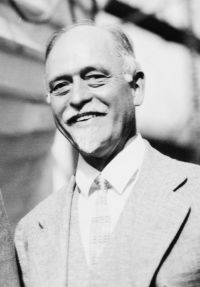
Portrait of Irving Fisher Irving Fisher The Purchasing Power of Money…

As prices rise, profits of business men, measured in money, will rise also, even if the costs of business were to rise in the same proportion. Thus, if a man who sold $10,000 of goods at a cost of $6000, thus clearing $4000, could get double prices at double cost, his profit would be double also, being $20,000—$12,000, which is $8000. Of course such a rise of prices would be purely nominal, as it would merely keep pace with the rise in price level. The business man would gain no advantage, for his larger money profits would buy no more than his former smaller money profits bought before.
Source: Wikisource

Portrait of Irving Fisher Irving Fisher The Purchasing Power of Money…

IV.14 But the amount of trade is dependent, almost entirely, on other things than the quantity of currency, so that an increase of currency cannot, even temporarily, very greatly increase trade. In ordinarily good times practically the whole community is engaged in labor, producing, transporting, and exchanging goods. The increase of currency of a "boom" period cannot, of itself, increase the population, extend invention, or increase the efficiency of labor.
Source: Wikisource

Portrait of Irving Fisher Irving Fisher The Purchasing Power of Money…

IV.6 It must be borne in mind that although business loans are made in the form of money, yet whenever a man borrows money, he does not do this in order to hoard the money, but to purchase goods with it. To all intents and purposes, therefore, when A borrows one hundred dollars from B in order to purchase, say, one hundred units of a given commodity at one dollar per unit, it may be said that B is virtually lending A one hundred units of that commodity.
Source: Wikisource

Get perspective with Kwize: daily news enlightened by great literature