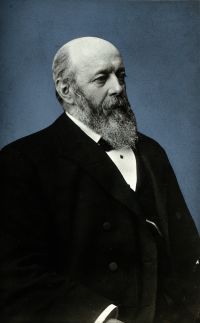
John Gray McKendrick

John Gray McKendrick

Summary

Portrait of John Gray McKendrick John Gray McKendrick 1911 Encyclopædia Britannica, Volume 9… (1911)

On the other hand, the acrobat on the wire-rope dare not trust his visual sensations in the maintenance of his equilibrium. He keeps his eyes fixed on one point instead of allowing them to wander to objects below him, and his muscular movements are regulated by the impulses that come from the skin and muscles of his limbs. The feeling of insecurity probably arises from a conception of height, and also from the knowledge that by no muscular movements can a man avoid a catastrophe if he should fall.
Source: Wikisource

Portrait of John Gray McKendrick John Gray McKendrick 1911 Encyclopædia Britannica, Volume 9… (1911)

A bird, on the other hand, depends largely on visual impressions, and it knows by experience that if launched into the air from a height it can fly. Here, probably, is an explanation of the large size of the eyes of birds. Cover the head, as in hooding a falcon, and the bird seems to be deprived of the power of voluntary movement.
Source: Wikisource

Portrait of John Gray McKendrick John Gray McKendrick 1911 Encyclopædia Britannica, Volume 9… (1911)

Thus from the limbs streams of nervous impulses pass to the sensorium from the skin and from muscles and tendons; these may or may not arouse consciousness, but they guide or evoke muscular movements of a co-ordinated character, more especially of the limbs.
In animals whose limbs are not adapted for delicate touch nor for the performance of complicated movements, such as some mammals and birds and fishes, the guiding sensations depend largely on the sense of vision. This sense in man, instead of assisting, sometimes disturbs the guiding sensation.
Source: Wikisource

Get perspective with Kwize: daily news enlightened by great literature