Summary

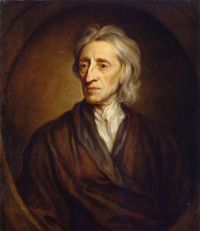
Portrait of John Locke John Locke An Essay Concerning Human Understanding…

For I ask any one, Whether he be not invincibly conscious to himself of a different perception, when he looks on the sun by day, and thinks on it by night ; when he actually tastes wormwood, or smells a rose, or only thinks on that savour or odour ? We as plainly find the difference there is between any idea revived in our minds by our own memory, and actually coming into our minds by our senses, as we do between any two distinct ideas. If any one say, a dream may do the same thing, and all these ideas may be produced in us without any external objects
Source: Wikisource

Portrait of John Locke John Locke An Essay Concerning Human Understanding…

For if we will reflect on our own ways of thinking, we will find, that sometimes the mind perceives the agreement or disagreement of two ideas immediately by themselves, without the intervention of any other : and this I think we may call intuitive knowledge. For in this the mind is at no pains of proving or examining, but perceives the truth as the eye doth light, only by being directed towards it. Thus the mind perceives that white is not black, that a circle is not a triangle, that three are more than two and equal to one and two.
Source: Wikisource

Portrait of John Locke John Locke An Essay Concerning Human Understanding…

It is on this intuition that depends all the certainty and evidence of all our knowledge ; Which certainty every one finds to be so great, that he cannot imagine, and therefore not require a greater : for a man cannot conceive himself capable of a greater certainty than to know that any idea in his mind is such as he perceives it to be ; and that two ideas, wherein he perceives a difference, are different and not precisely the same. He that demands a greater certainty than this, demands he knows not what, and shows only that he has a mind to be a sceptic, without being able to be so.
Source: Wikisource

Get perspective with Kwize: daily news enlightened by great literature