Summary

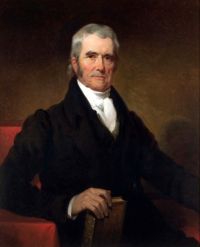
Portrait of John Marshall John Marshall Bank of Hamilton v. Jun — Opinion of the Court

If a court of limited and circumscribed jurisdiction can legitimately exercise general powers, no good reason can be given why the court of common pleas should not be sustained in assuming the peculiar powers and jurisdiction of this Court. If an assumed power is valid for one purpose and for one occasion, it is valid for all and every purpose. There is no rule construction, by which the limited and circumscribed jurisdiction of the court of common pleas, can be made so broad and reaching in its character, as to embrace the orders of 1804 and 1805.
Source: Wikisource

Portrait of John Marshall John Marshall Bank of Hamilton v. Jun — Opinion of the Court

That a court of record, whose proceedings can be proved by the record alone, should, at a subsequent term, determine that an order was made at a previous term, of which no trace could be found on its records, and that too after the repeal of the law which gave authority to make such an order; is a proceeding of so much delicacy and danger, which is liable to so much abuse; that some of us question the existence of the power.
Source: Wikisource

Portrait of John Marshall John Marshall Bank of Hamilton v. Jun — Opinion of the Court

In exploring this intention, in all cases of ambiguity, the judgment is submitted to the guidance of certain familiar rules of construction. We look back upon the old law, and trace its effects upon community, with an eye to its mischievous influence; and we consider well the remedy or policy of the law given in the enactment of the new law. Now, the liability of real estate in the hands of an administrator for the just debts of his intestate, is a sacred elementary principle to be found in all the codes of the different states of this union, introduced originally by an act of parliament.
Source: Wikisource

Get perspective with Kwize: daily news enlightened by great literature