Summary

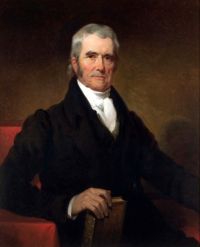
Portrait of John Marshall John Marshall Bank of the United States v. Ritchie…

It must be conceded that an erroneous decree, made on the proof in a cause, may be reversed for error appearing on its face; as where an absolute decree is made against an infant defendant. So such erroneous decree, taken by consent of the infant, his guardian or attorney, is reversible in like manner; for an infant is not within the maxim, 'consensus tollit errorem.'
Again, it is objected, that the original decree in this cause has not been performed, and that a bill of review will not lie until the decree has been performed.
Source: Wikisource

Portrait of John Marshall John Marshall Bank of the United States v. Ritchie…

The statute under which the court acted, authorises a sale of the real estate, only where the personal estate shall be insufficient for the payment of debts, when the justice of the claims shall be fully established, and when, upon consideration of all circumstances, it shall appear to the chancellor, to be just and proper that such debts should be paid, by a sale of the real estate.
Source: Wikisource

Portrait of John Marshall John Marshall Bank of the United States v. Ritchie…

It has been insisted on, that the omission in the decree, to give a day to the minor, is, in this case, no error, because it is a decree for the sale of land for the payment of debts: to which it is answered, that when the infant is decreed to join in the conveyance, even in a sale under a mortgage, he is entitled to a day. The court will not direct an infant to part with his inheritance, without a day being reserved to him in the decree.
Source: Wikisource

Get perspective with Kwize: daily news enlightened by great literature