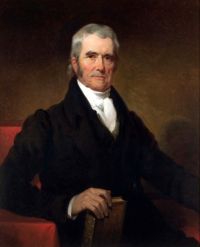
Summary

Portrait of John Marshall John Marshall Elmendorf v. Taylor — Opinion of the Court

Thus, no Court in the universe, which professed to be governed by principle, would, we presume, undertake to say, that the Courts of Great Britain, or of France, or of any other nation, had misunderstood their own statutes, and therefore erect itself into a tribunal which should correct such misunderstanding. We receive the construction given by the Courts of the nation as the true sense of the law, and feel ourselves no more at liberty to depart from that construction, than to depart from the words of the statute.
Source: Wikisource

Portrait of John Marshall John Marshall Elmendorf v. Taylor — Opinion of the Court

But, the statute of limitations, which bars an ejectment after the lapse of twenty years, constitutes no bar to a writ of right, even where the tenant counts on his own seisin, until thirty years shall have elapsed. Whether a Court of equity considers an equitable claim to land as barred when the right of entry is lost, or will sustain a bill as long as the mere right may be asserted, is a question of some difficulty, and of great importance.
Source: Wikisource

Portrait of John Marshall John Marshall Elmendorf v. Taylor — Opinion of the Court

The analogy of a bill in equity to actions founded on a right of entry, seems to derive some title to consideration, from the circumstance, that the plaintiff does not sustain his claim on his own seisin, or that of his ancestor, but on an equity not necessarily accompanied by seisin, whereas seisin is an indispensable ingredient in a writ of right.
Source: Wikisource

Get perspective with Kwize: daily news enlightened by great literature