Summary

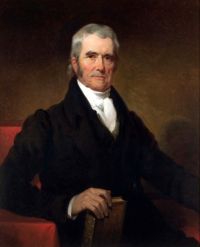
Portrait of John Marshall John Marshall Harding v. Handy — Opinion of the Court

It is the peculiar province of a Court of conscience, to set them aside. That a Court of equity will interpose in such a case, is among its best settled principles. The cases cited in the argument, which we will not repeat, place this beyond the possibility of question. It was, therefore, proper to set aside the deeds, and to direct the defendant, Handy, to account for the money he had received under them.
Source: Wikisource

Portrait of John Marshall John Marshall Harding v. Handy — Opinion of the Court

Deeds may be obtained from a weak man for the purpose of preserving his estate for himself and family, and of protecting him from the impositions to which he might be exposed; and there is nothing to restrain one of the heirs, who may think himself aggrieved, from bringing the whole case before a Court of equity. If, indeed, it were true in fact, that the bill does not allege this incompetency so as to put it in issue, the objection would be conclusive; for, it is well settled, that the decree must conform to the allegations of the parties.
Source: Wikisource

Portrait of John Marshall John Marshall Harding v. Handy — Opinion of the Court

We think, then, that there is error in proceeding to decree a sale, without bringing all those heirs before the Court who can be brought before it; and for this error, the decree must be reversed, and the cause sent back, with liberty to the plaintiffs to amend their bill by making proper parties. If all the heirs cannot be brought before the Court, the undivided interest of those who do appear, is to be sold, and the lien of Asa Handy is to remain on the part or parts unsold, to secure the payment of so much of the money due to him as those parts may be justly chargeable with.
Source: Wikisource

Get perspective with Kwize: daily news enlightened by great literature