Summary

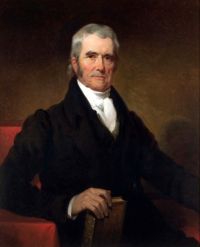
Portrait of John Marshall John Marshall The Friendschaft — Opinion of the Court

It cannot be believed, that, admitting farther proof in the absence of an invoice or letter of advice, endangers the fair rights of belligerents. These papers are so easily prepared, that no fraudulent case would be without them. It is not to be credited, that a shipper in London, consigning his own goods to a merchant in Lisbon, with the intention of passing them on a belligerent cruizer as neutral, would omit to furnish a letter of advice and invoice, adapted to the occasion.
Source: Wikisource

Portrait of John Marshall John Marshall The Friendschaft — Opinion of the Court

It is contended, with great earnestness, that farther proof ought not to have been ordered, and that the goods which have been restored, ought to have been condemned as prize of war. In support of this proposition, the captors, by their counsel, insist that the rights of belligerents would be sacrificed, should a mere bill of lading, consigning the goods to a neutral, unaccompanied by letter of advice or invoice, let in the neutral claimant to farther proof.
Source: Wikisource

Portrait of John Marshall John Marshall The Friendschaft — Opinion of the Court

They do not identify the two nations with each other, or effect those principles on which, in other cases, a merchant acquires the character of the nation in which he resides and carries on his trade. If a British merchant, residing in Portugal, retains his British character when Britain is at war and Portugal at peace, he would also retain that character when Portugal is at war and Britain at peace.
Source: Wikisource

Get perspective with Kwize: daily news enlightened by great literature