Summary

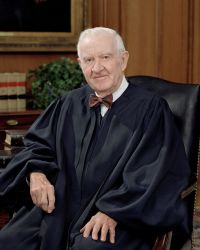
Portrait of John Paul Stevens John Paul Stevens Renne v. Geary — Opinion of the Court

But the greater power to dispense with elections altogether does not include the lesser power to conduct elections under conditions of state-imposed voter ignorance. If the State chooses to tap the energy and the legitimizing power of the democratic process, it must accord the participants in that process-voters, candidates, and parties-the First Amendment rights that attach to their roles.
Source: Wikisource

Portrait of John Paul Stevens John Paul Stevens Renne v. Geary — Opinion of the Court

If the existence of overlapping laws could defeat redressability, legislatures would simply pass "backup" laws for all potentially unconstitutional measures. Thereafter, whenever an aggrieved party brought suit challenging the State's infringement of his constitutional rights under color of one law, the State could advert to the existence of the previously unrelied-upon backup law as an alternative basis for continuing its unconstitutional policy, thereby defeating the aggrieved party's standing.
Source: Wikisource

Portrait of John Paul Stevens John Paul Stevens Renne v. Geary — Opinion of the Court

Those concerns, however, should not prevent us from independently examining the record and deciding the issues that are properly presented. In doing so, I conclude that the only constitutional challenge that is properly before us is to the action by the San Francisco Registrar of Voters in deleting references in official voter pamphlets to political party endorsements, a challenge that is fully justiciable. Because the Registrar's action does not violate the First Amendment, I would reverse the judgment of the Court of Appeals. I therefore dissent from the majority's disposition of this case.
Source: Wikisource

Get perspective with Kwize: daily news enlightened by great literature